A Tale of Two Wires.
My friend Bill and I have been curious about our personal antenna choices while out doing Parks On The Air.
We, like many of you, have collected a variety of antennas for our hobby. Long, short, horizontal, vertical, end fed, center fed, off-center fed, easy to deploy, and not so easy.
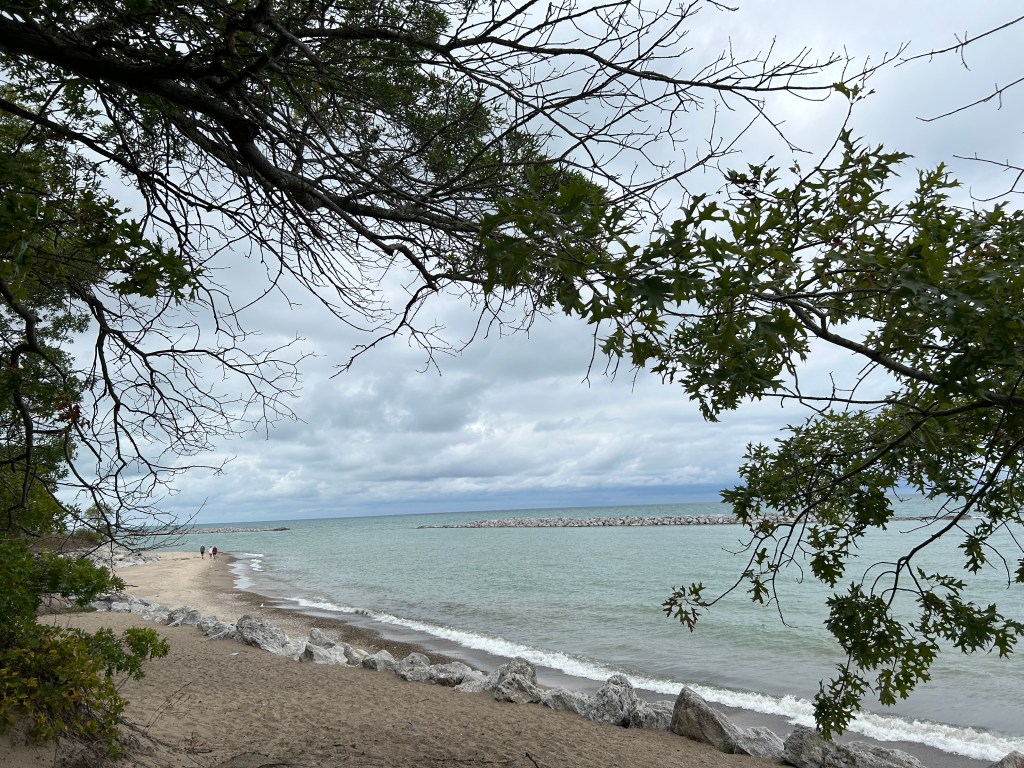
I’m not a scientist. I don’t play one on TV. I didn’t sleep at Holiday Inn Express the night before this little experiment. What I’m going to share is my results from a recent POTA outing at my home park, (is that an oxymoron?), Illinois Beach State Park, K-1000 US-1000. The park is in extreme northeast Illinois on the shore of Lake Michigan.
Without getting too sciencey, this seemed like a reasonable apples to apples comparison. Certainly, good enough for hobbyist use. I collected the data from our logging software and boiled it down as a spreadsheet, (not shown).
Bill and I were both operating FT8 and each of us was using a Xiegu G-90 at ten Watts. He was at one end of the picnic table, and I was at the other end. Both of our antennas were oriented northeast southwest.
Bill’s antenna was a Spark Plug antenna which is an end fed wire. Installed as a sloper, one end was about 25-30 feet up in a tree and the connector end was about 6 feet above the ground. His was a typical deployment of the antenna. A run of not more than 25 feet of LMR-100 connected the antenna to the G-90.
My antenna was an off-center fed dipole about 30 feet up in the air, flat top, between two trees. 25 feet of LMR-100 feedline connected the antenna to my radio.
What we were curious about was to what lengths does one need to go to have a great day out playing radio? At some point is there diminishing return with your impromptu antenna farm? With a dipole comes challenge of deploying an antenna which needs two supports, possibly three. Would I be rewarded by significantly enhanced propagation versus the easy-to-deploy end fed? We were about to find out…
In our outing one operator made 44 FT8 QSOs and the other operator made 40. Close enough. Measure it with a micrometer, mark it with a grease pencil, cut it with a chain saw.
Given the low noise floor out at the park neither of us were stunned by the results. For the most part we operated on 20 meters.
The end fed Spark Plug antenna from Sparkpluggear.com gave these results for 44 contacts: Average distance 1700miles with the farthest contact being 7023 miles away in Spain. Average signal report received, -7. Average signal report sent, 6.
The results for the OCF dipole from N9SAB, for 40 FT-8 QSOs: Average distance was 1728 miles with the farthest contact being in Ukraine. 8052 miles. Average signal report received -2. Average signal report sent -3.

The signal reports, (RST), are a measure of how well one station is hearing the other. “RST Received” is how well the other station is hearing you. “RST Sent” is how well you are hearing them. The strength of the received signal is expressed as plus or minus decibels. +19dB is about the best you should expect, (although you will see higher with particularly good stations), down to about -24dB. The dB value is the amount above or below some mathematically derived noise floor.
“Wait a minute. I asked you what time it is, and you told me how to build a clock.” If you want to get a lot smarter than me about SNR and Signal Reports, you can read this article by Tucson Amateur Packet Radio.
So, there you have it. Not much of a difference in our small sample size experiment, but if you value ease of deployment, the end fed antenna gave us the most bang for our buck with no appreciable loss of performance.
On the other hand, since we were also evaluating our DIY pneumatic antenna launchers, PAL, the dipole gives us twice the opportunity to “fine tune” the antenna launcher.
73
Bill
 KD9TWA.com