Side By Side Wire Antenna Comparison

A Tale of Two Wires.

My friend Bill and I have been curious about our personal antenna choices while out doing Parks On The Air.

We, like many of you, have collected a variety of antennas for our hobby. Long, short, horizontal, vertical, end fed, center fed, off-center fed, easy to deploy, and not so easy.

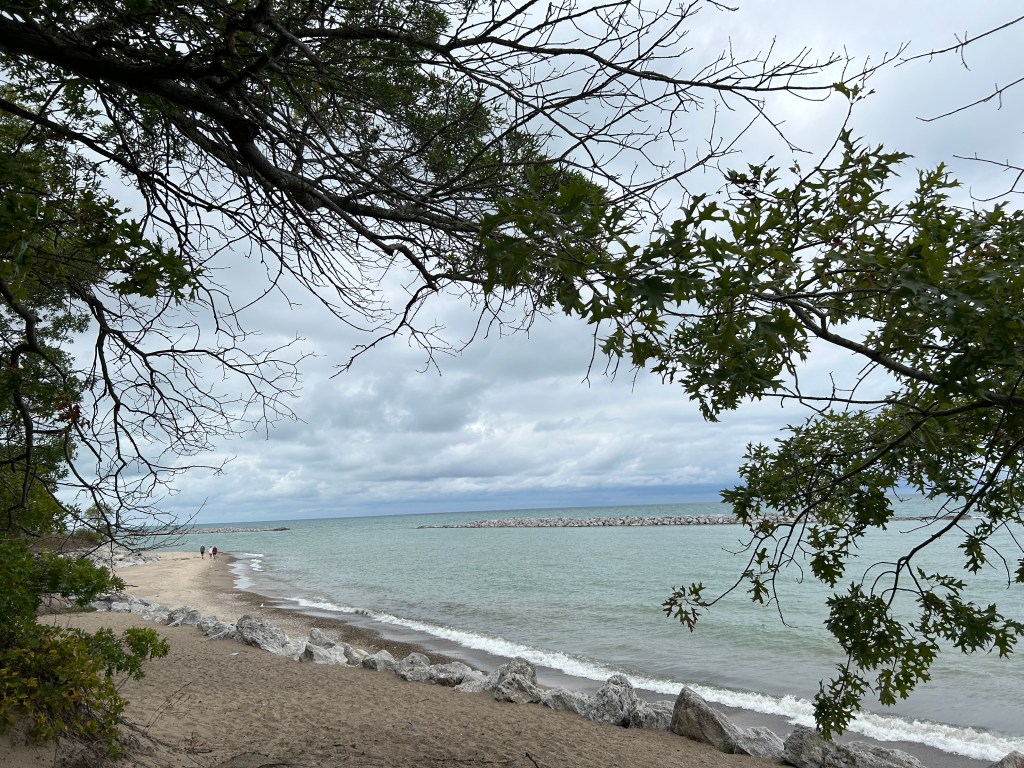
I’m not a scientist. I don’t play one on TV. I didn’t sleep at Holiday Inn Express the night before this little experiment. What I’m going to share is my results from a recent POTA outing at my home park, (is that an oxymoron?), Illinois Beach State Park, K-1000 US-1000. The park is in extreme northeast Illinois on the shore of Lake Michigan.
Without getting too sciencey, this seemed like a reasonable apples to apples comparison. Certainly, good enough for hobbyist use. I collected the data from our logging software and boiled it down as a spreadsheet, (not shown).

Bill and I were both operating FT8 and each of us was using a Xiegu G-90 at ten Watts. He was at one end of the picnic table, and I was at the other end. Both of our antennas were oriented northeast southwest.

Bill’s antenna was a Spark Plug antenna which is an end fed wire. Installed as a sloper, one end was about 25-30 feet up in a tree and the connector end was about 6 feet above the ground. His was a typical deployment of the antenna. A run of not more than 25 feet of LMR-100 connected the antenna to the G-90.

My antenna was an off-center fed dipole about 30 feet up in the air, flat top, between two trees. 25 feet of LMR-100 feedline connected the antenna to my radio.

What we were curious about was to what lengths does one need to go to have a great day out playing radio? At some point is there diminishing return with your impromptu antenna farm? With a dipole comes challenge of deploying an antenna which needs two supports, possibly three. Would I be rewarded by significantly enhanced propagation versus the easy-to-deploy end fed? We were about to find out…

In our outing one operator made 44 FT8 QSOs and the other operator made 40. Close enough. Measure it with a micrometer, mark it with a grease pencil, cut it with a chain saw.

Given the low noise floor out at the park neither of us were stunned by the results. For the most part we operated on 20 meters.

The end fed Spark Plug antenna from Sparkpluggear.com gave these results for 44 contacts: Average distance 1700miles with the farthest contact being 7023 miles away in Spain. Average signal report received, -7. Average signal report sent, 6.

The results for the OCF dipole from N9SAB, for 40 FT-8 QSOs: Average distance was 1728 miles with the farthest contact being in Ukraine. 8052 miles.  Average signal report received -2. Average signal report sent -3.

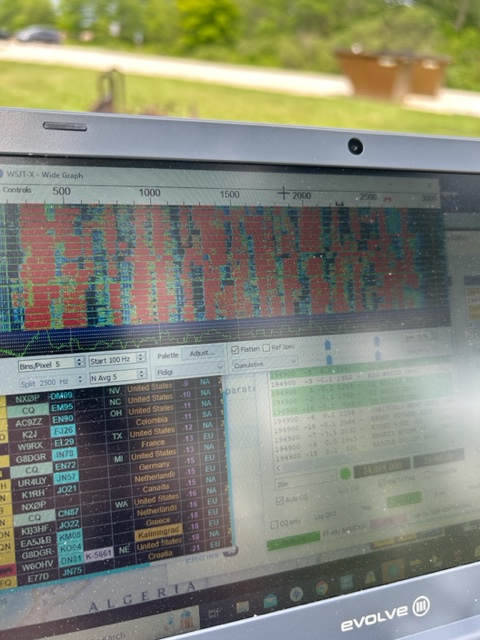
The signal reports, (RST), are a measure of how well one station is hearing the other. “RST Received” is how well the other station is hearing you. “RST Sent” is how well you are hearing them. The strength of the received signal is expressed as plus or minus decibels. +19dB is about the best you should expect, (although you will see higher with particularly good stations), down to about -24dB. The dB value is the amount above or below some mathematically derived noise floor.

“Wait a minute. I asked you what time it is, and you told me how to build a clock.” If you want to get a lot smarter than me about SNR and Signal Reports, you can read this article by Tucson Amateur Packet Radio.

So, there you have it. Not much of a difference in our small sample size experiment, but if you value ease of deployment, the end fed antenna gave us the most bang for our buck with no appreciable loss of performance.

On the other hand, since we were also evaluating our DIY pneumatic antenna launchers, PAL, the dipole gives us twice the opportunity to “fine tune” the antenna launcher.
73

Bill
On the Shore of Lake Michigan Playing Radio

The short version: A beautiful July day, POTA, K-1000, 34 contacts, Hamstick stabbed into the ground.

After the hot, wet, smokey weather we’ve had lately in the Chicago area it was a good great day to take a trip up to Illinois Beach State Park for a quick POTA activation. Sunny, 75 degrees F and a light breeze off Lake Michigan.

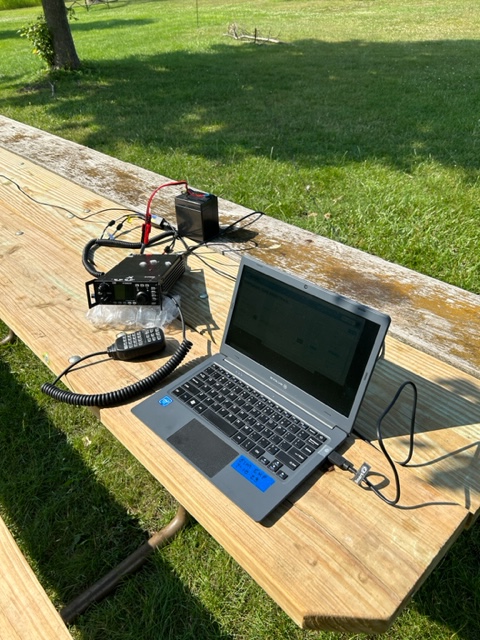
In the interest of packing light, I brought a Xiegu G-90, a small LiFPO battery, an Evolve III mini-laptop, an antenna analyzer, and a 20m Hamstick. This wasn’t a DX-pedition.

On the radio end is the Xiegu G-90 interfaced to the small laptop via the flawless DigiRig external soundcard. My plan was to focus on F4 and FT8 operations today, but I did make a couple of SSB Park to Park contacts too.

The 20-meter band was hoppin’.

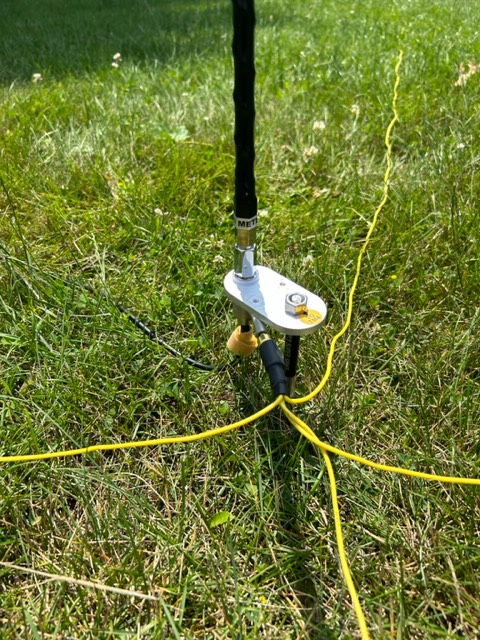
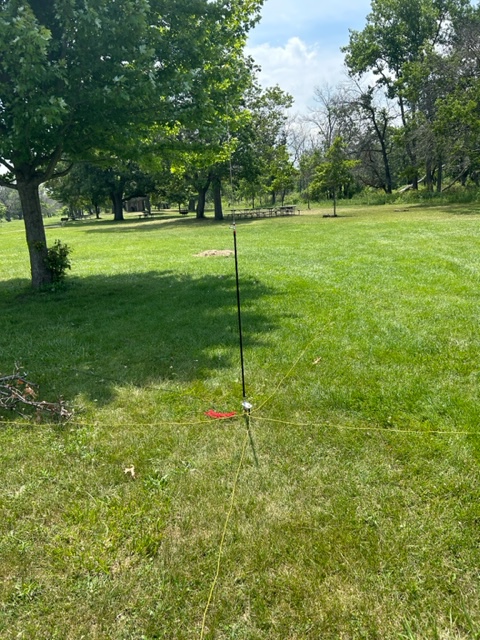
The antenna system, (sounds fancy, right?), was a 20m Hamstick screwed into a SuperAntenna UM3 SuperMount attached to the SuperSpike. The helically wound whip, AKA Hamstick, was screwed into the SuperMount and the whole thing stabbed into the ground. The moist, sandy soil made pushing the stake into the ground a breeze.

I attached a set of four ground radials and proceeded to tune the antenna. The ground radials are just laid out in four directions from the antenna. Nothing scientific. Whatever space and obstructions permit.

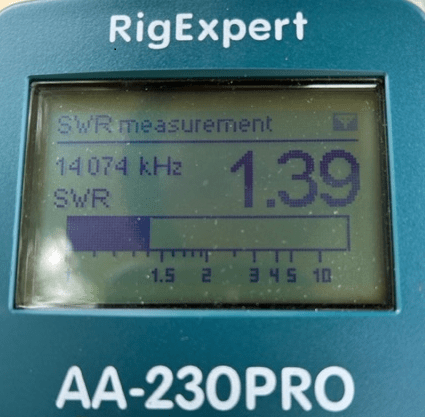
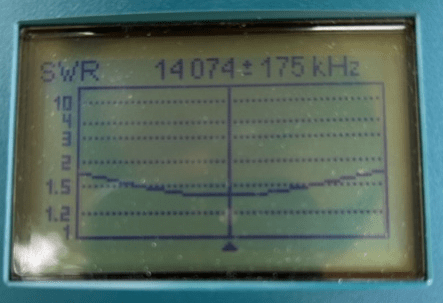
The results after tuning weren’t spectacular, but there comes a point of diminishing returns. The 80/20 rule applies. It usually takes 20% of the time to complete 80% of a task while it takes 80% of the effort to complete the last 20%. I tuned the antenna for 20 meter FT8 and called it good. The G-90 has a great internal tuner BTW.

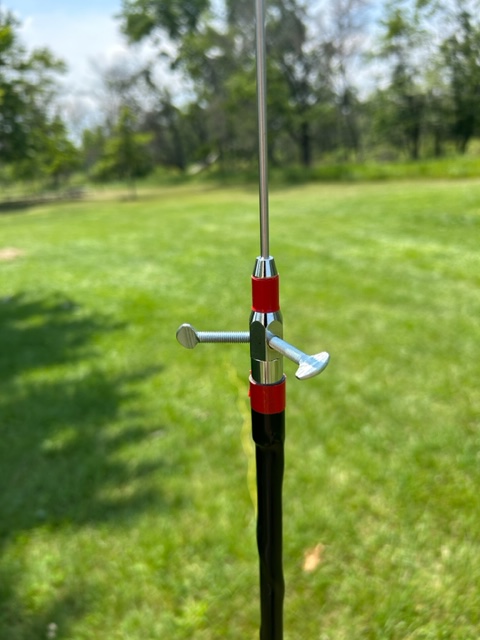
In his book Successful POTA: The WV1W Illustrated Guide to Parks On The Air, author Don Dickey suggests replacing the Allen wrench setscrews on your Hamstick “stinger” with thumbscrews. Mine are 10-32 thread, but bring the stinger with you to the hardware store just to be safe. No more misplaced Allen wrenches. Yay!

The final outcome was picture-perfect day spent at the lake with 34 contacts in the log, including a Park to Park contact with K2L, one of the 13 Colonies Contest stations. Max power today was 15 Watts.

As far as the bare-bones station goes, I feel like it was a winner.

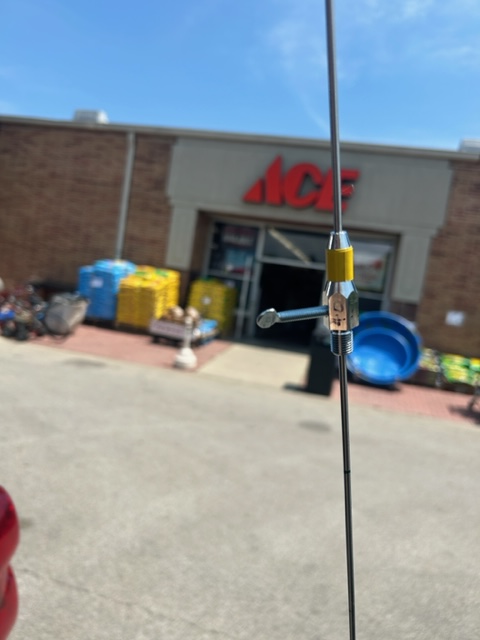
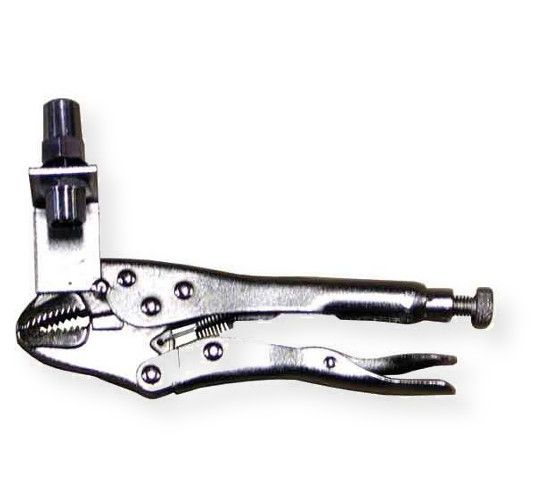
Next time I’m going to try a locking plier setup similar to the SuperMount. The park has an abundace of heavy duty metal BBQ grills scattered around the park.

Seven Tree

December 2021. What the heck is POTA?

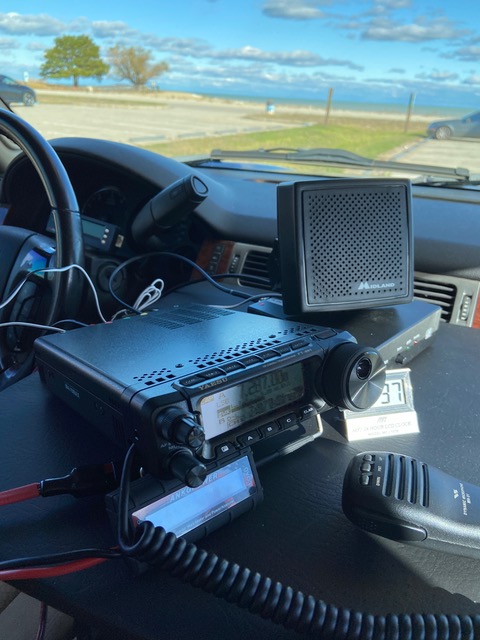
Sometimes you don’t even need to get out of your vehicle.

POTA is the acronym for Parks On The Air. It’s a relative of Islands On The Air, (IOTA), Summits On The Air, (SOTA), and even World Lighthouse On The Air, (WLOTA).

From the Parks On The Air website, they say POTA is …international portable amateur radio operations that promote emergency awareness and communications from national/federal and state/provincial level parks.

Any properly licensed ham can participate and earn awards. You must register with this all-volunteer organization to reap the full benefits of the POTA community, but you can give it a test drive without registering. You’ll probably register once you find out how fun it is.

For the full year of 2016 the ARRL did a parks on the air thing commemorating the Centennial of the National Park Service to Promote the capabilities of Amateur Radio to the general public through operations at eligible NPS Administrative Units, according to the ARRL. It was called National Parks on the Air.

It was such a huge success that a group of volunteers took the ball and ran with it giving us POTA as we know it today.

Operators can participate in POTA from home as a Hunter or afield as an Activator. Two Activators can contact one another for a “Park to Park” contact which is another recognized award category. POTA is also a good place to practice your low power, (QRP), skills. Phone, check. CW, check. Digital, check. Want to activate multiple parks in one day? Oh yah, there are awards for that too. There is something for everyone.

One nice feature of POTA is that you can self-spot through their website, which means that you advertise what frequency and at which park you are operating. Hunters can find you with ease on a computer or smartphone. After making a QSO, most hunters will re-spot you which is then updated on the website. As an activator you’ll have your ten contacts in no time. As a Hunter, you’ll be able to pile up those QSOs.

After you listen for a while you’ll notice there are many couples who do POTA. It’s also quite common to hear, “Stand by for a second, (or third or even fourth), operator”.

My suggestion would be to visit POTA and check out the great info there. While you’re there you might as well register.

Soon I’ll discuss how POTA can make you a better ham radio operator. Believe me, it really will.

Seven Tree

My interest with Parks On The Air, POTA, and Amateur Radio in general.

Bong Recreation Area Wisconsin USA

My initial interest with this blog is to be able to share my current interest with POTA through words and pictures. Hopefully you will find it interesting, and maybe pique your interest in this little corner of the radiosport world.
As I become more proficient, (with the blog), I’ll begin to add content relating to my experiences as a new amateur radio operator. I’ll also address some of the challenges “new” hams will face and some of the solutions that have worked for me.